Article: The Engineering of the Soundboard: Energy Transfer from the Bridge to the Wood
The Engineering of the Soundboard: Energy Transfer from the Bridge to the Wood

1. The Hidden Physics of the Instrument: What Is Guitar Bracing and Why Does It Define Timbre?
The soundboard is not a passive piece of wood: it is the true acoustic engine of the classical guitar.
Since a vibrating string displaces an insignificant volume of air, the quality, volume, and timbre of the instrument depend 100% on the efficiency with which the internal bracing transfers and modulates mechanical energy from the bridge to the wood.
In high-end lutherie, bracing solves a critical engineering equation: maximizing structural rigidity against the constant tension of over 40 kg from the strings, while minimizing the mass of the top to the absolute limit.
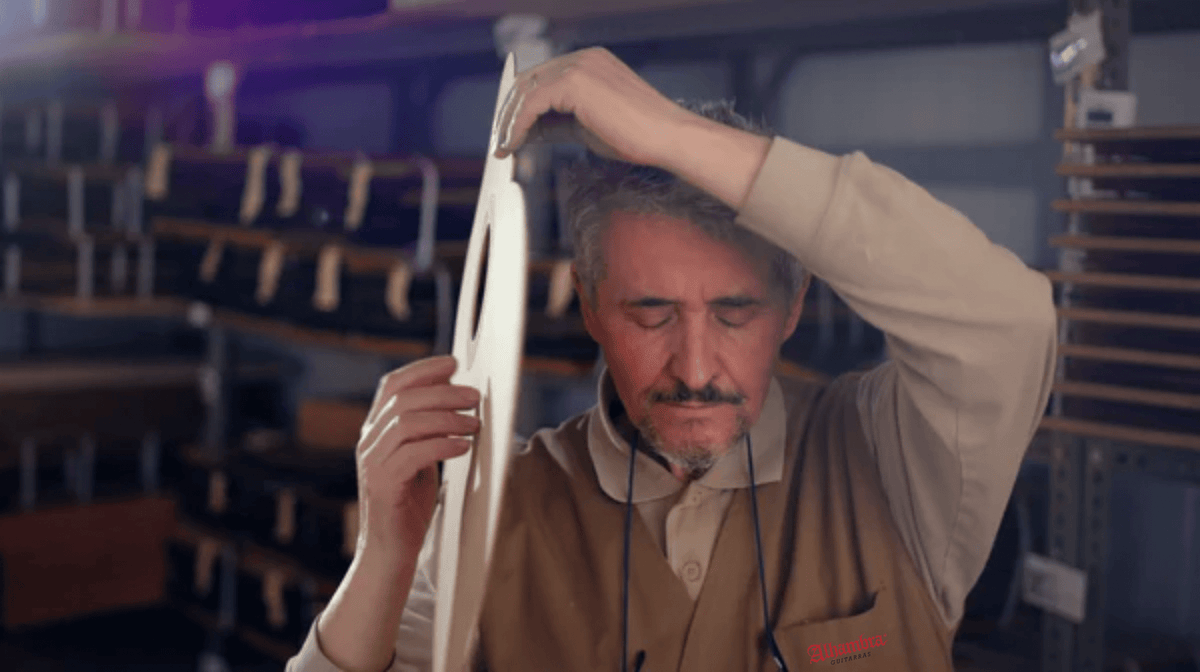
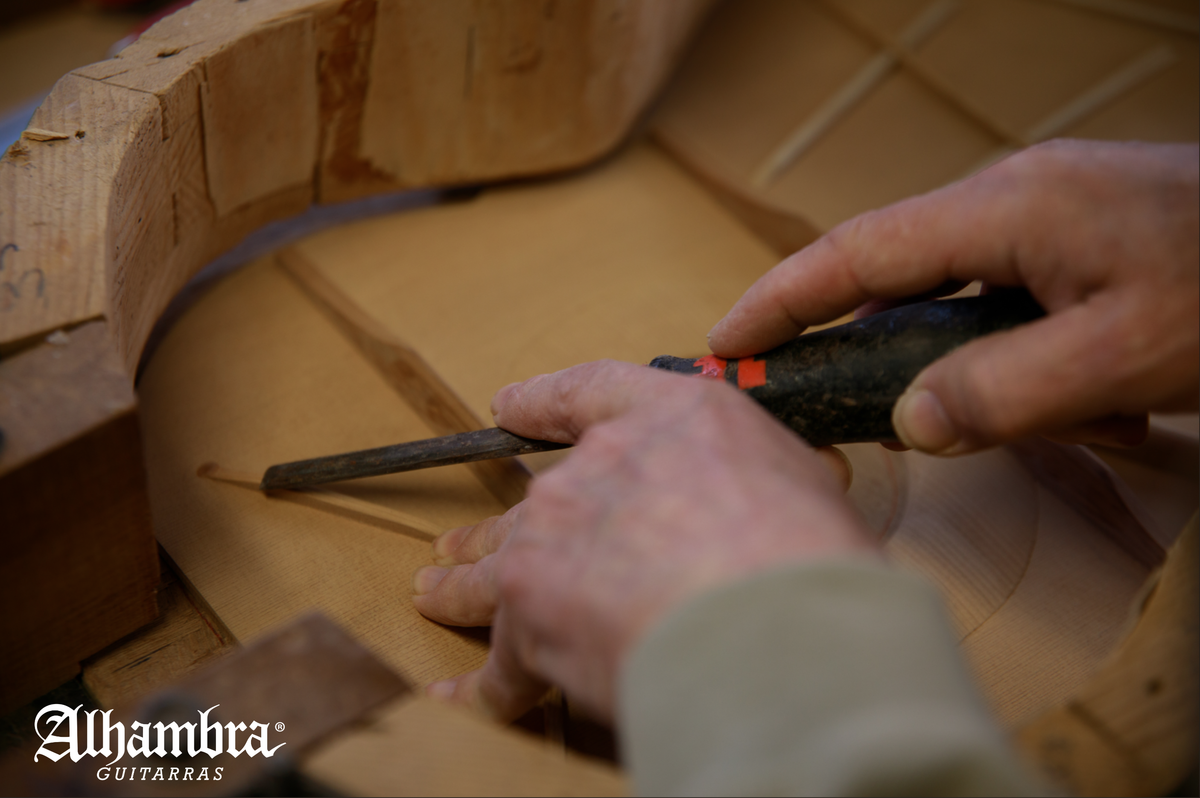
In the Alhambra workshop in Muro de Alcoy, we combine the historical legacy of the Spanish guitar with acoustic R&D&i processes to develop distinct internal architectures adapted to every level of performance demand.
Bracing fulfills two critical and opposing functions from an engineering perspective:
- Structural resistance: Withstanding the constant tension of the strings (ranging between 35 and 45 kg), preventing the wooden soundboard from deforming or collapsing over time.
- Acoustic conductivity and modulation: Directing vibrational waves and modulating soundboard flexibility to enhance bass response, define trebles, and maximize sustain.
The Lutherie Principle at Alhambra: Minimizing the total mass of the bracing while increasing structural rigidity at key nodal points. The lighter the soundboard, the greater its vibrational freedom and overall acoustic performance.
2. Evolution of Bracing: From Antonio de Torres to Contemporary Master Lutherie
Since Antonio de Torres laid the foundations of the modern classical guitar in the 19th century through the symmetrical fan bracing pattern, the pursuit of greater volume for concert halls has driven our master luthiers in Muro de Alcoy to evolve internal bracing architecture.
Below, we analyze the direct influence of this internal architecture on real-world acoustics, utilizing three Alhambra models representing three levels of structural complexity.
Level 1: High-Clarity Fan Bracing (3 Struts): Mass Minimization

Reference model: Alhambra 1 C HT Hybrid Terra
In entry-level and intermediate models, the main priority is lightening the structure so the soundboard responds fluently without requiring an overly aggressive plucking force from the player.
- Technical challenge: Delivering rapid and clean sound projection without requiring excessive force from the performer.
- Acoustic response: By minimizing internal wood density, the soundboard vibrates freely under light touch. It offers a clean, warm, and direct tone—an open timbre, albeit with a more constrained dynamic range and sustain during highly demanding concert passages.
- Recommended profile: Students and guitarists seeking an agile, lightweight instrument with immediate sound projection.
🔊 Audio Sample: Alhambra 1 C HT Hybrid Terra (Classical 3 Bracing)
Listen to the responsive attack and clear projection provided by the 3-strut fan bracing.Level 2: Transverse-Stabilized Fan Bracing (7 Struts + Bridge Bar): Polyphonic Balance

Reference model: Alhambra 7 P Classic
For advanced conservatory and semi-professional level guitars, structural demands require superior control over secondary frequencies and overtones.
-
Technical challenge: Controlling parasitic frequencies, expanding dynamic range, and achieving clear voice separation between bass and treble lines in complex polyphonic passages.
-
The solution: Inspired by the historical developments of Robert Bouchet, this design adds a transverse bar beneath the bridge to articulate the 7-strut fan. This reinforcement stabilizes top vibrations, producing a richer tonal palette with increased bass projection, full-bodied clear trebles, and remarkable voice separation in polyphonic playing.
-
Recommended profile: Advanced players and concert performers who require a wide dynamic range (from pianissimo to fortissimo) without losing tonal definition.
Level 3: Lattice Architecture: The Concert Diaphragm

Reference model: Mengual & Margarit Serie C
At the pinnacle of contemporary master lutherie at Alhambra, master luthiers Florentino Mengual and José María Margarit implement lattice architecture.
-
Technical challenge: Generating maximum acoustic power and volume projection capable of filling a major auditorium without losing the noble timbre of natural wood.
-
Engineering solution: Developed under the direct supervision of master luthiers Mengual and Margarit, lattice bracing replaces parallel struts with a three-dimensional grid structure. This geometry allows the soundboard thickness to be reduced to absolute minimum values while maintaining complete structural stiffness. The soundboard acts as a continuous acoustic diaphragm, delivering extraordinary volume, effortless projection across concert halls, and prolonged sustain with uniform treble response up the upper frets.
-
Recommended profile: Professional soloists and concert artists requiring maximum volume power, stage presence, and dynamic control.
🔊 Audio Sample: Mengual & Margarit Serie C (Lattice Bracing)
Experience the output power, room-filling projection, and extended sustain unique to the Lattice structural framework.3. Technical Performance Comparison
| Guitar Model | Bracing System | Structure / Density | Attack Response | Volume and Projection | Recommended Use |
| Alhambra 1 C HT Hybrid Terra | Symmetrical Fan (3 Struts) | Lightweight / Minimal Mass | Immediate and agile | Moderate (Intimate settings) | Beginner / Initial Study |
| Alhambra 7 P Classic | Advanced Fan (7 Struts + Bridge Bar) | Medium / Balanced | Dynamic and rich in overtones | High (Rehearsal halls / Recitals) | Advanced Study / Concert Player |
| Mengual & Margarit Serie C | Lattice (Lattice Bracing) | Complex / Ultra-lightweight | Precise / Extended sustain | Maximum (Large Auditoriums) | Professional / Concert Soloist |

4. Frequently Asked Questions About Classical Guitar Bracing
Which classical guitar offers the best sound based on its bracing system?
There is no single "perfect" bracing design, but rather an architecture tailored to specific requirements. If maximum volume and projection for large concert halls are required, the Lattice Bracing featured in the Mengual & Margarit Serie C represents the superior choice. To achieve traditional Spanish tone characterized by warmth, balance, and harmonic depth, the 7-strut 50th Anniversary fan bracing (as found on the Alhambra 7 P Classic) remains the golden benchmark.
How does the wood used for bracing struts influence resonance?
Bracing struts are typically carved from straight-grained woods boasting high stiffness-to-weight ratios, such as German Spruce or Canadian Cedar. Spruce offers greater rigidity, translating into a focused, bright tone with strong treble projection. Cedar, on the other hand, adds warmth and promotes fast, immediate volume response across low frequencies.
Does a more complex bracing design always guarantee a better instrument?
No. Complex bracing structures like Lattice demand perfectly seasoned tonewoods and precise hand-calibrated voicing (tap tuning). If a complex bracing pattern is built with excessive mass or heavy glue, it will over-stiffen the soundboard and stifle the sound. Quality depends on technical precision during the hand-shaping and individual profiling of each strut—a process handcrafted in the Alhambra workshop in Muro de Alcoy.